
The Local Economy in Polycrisis
The structural failures that are making our communities poor.
The Anatomy of Decline
Our research identifies root causes that converge to extract wealth and suppress potential. We group these into three structural failures: Extraction, Exclusion, and Illusion.
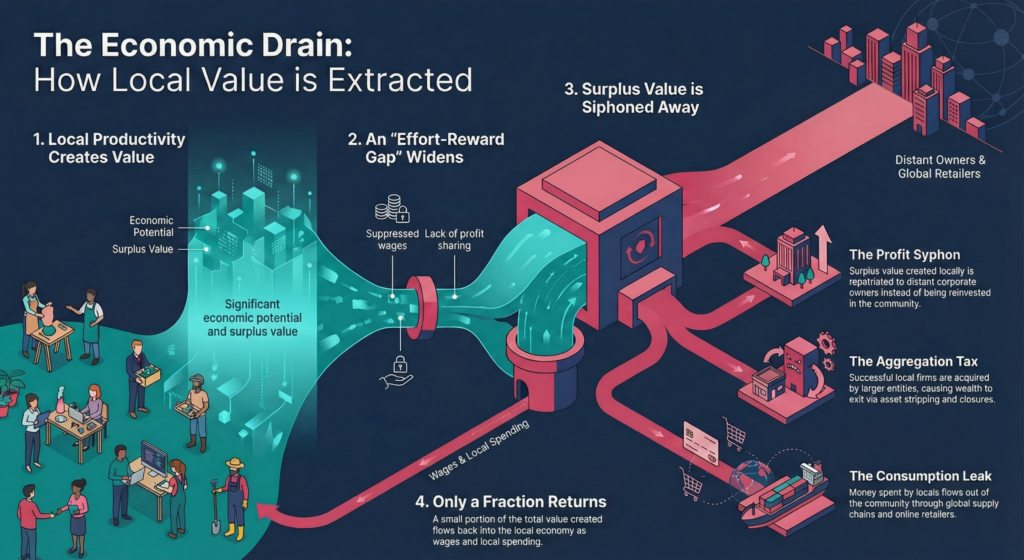
The modern economy may be creating jobs in communities but it is extracting wealth from them.
The Branch Plant Paradox: Corporations open local satellite offices to access lower wages, but the surplus value—the profits—are systematically repatriated to distant shareholders rather than reinvested locally.
The Aggregation Tax: Success is often punished. When a sovereign local firm grows, it is often acquired by a larger entity. This ‘Aggregation Tax’ instantly transforms a local engine of investment into a passive asset that exports its yield.
The Effort-Reward Gap: Local workers deliver the productivity, but external shareholders capture the prosperity. Without a stake in the profits they help create, work becomes a recipe for burnout rather than a path to wealth.
The Consumption Leak: In the digital age, money flows out of our towns effortlessly—global supply chains and online access to external retailers continues to reduce spending in the local economy.
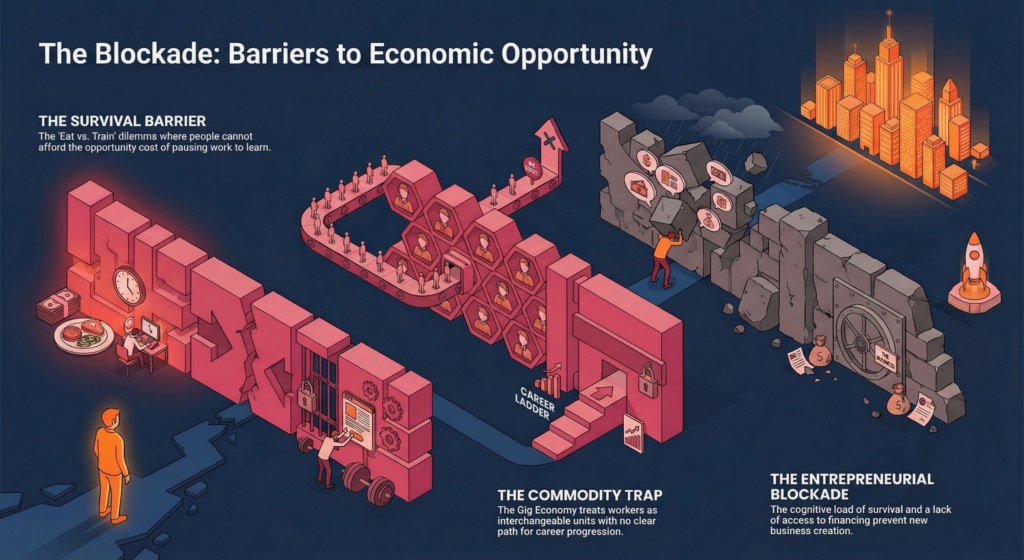
Systemic barriers prevent talent from genuinely sharing in the modern economy.
The Survival Barrier: The “earning vs. learning” dilemma. Low-income workers cannot afford the opportunity cost of pausing work to retrain, trapping them in a low-skill equilibrium despite their potential.
The Entrepreneurial Blockade: For aspiring founders, the lack of access to capital and the ‘cognitive load’ of financial survival make the risk of starting a business impossible, leaving vast reserves of local innovation untapped.
The Commodity Trap: The gig economy treats workers as interchangeable units. This creates a negative labour signal, labelling capable people as low-skill ‘ghost workers’ and denying them the professional development needed for upward mobility.
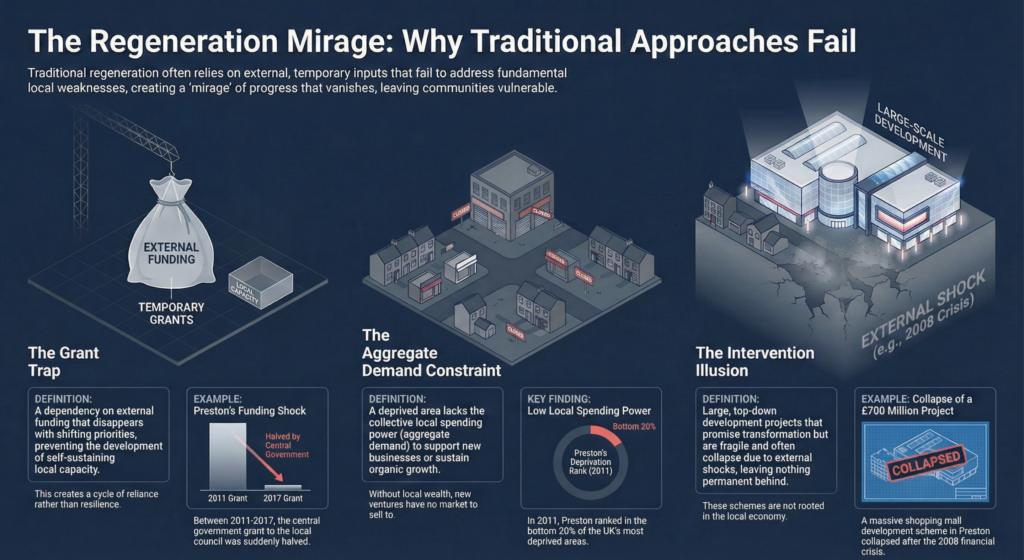
Why short-term grants and ‘buying local’ cannot fix a structural demand deficit.
The Grant Trap: Decades of ‘parachute’ funding have created dependency on cycles of temporary, external funding. Projects appear when grants are available and vanish when priorities change, failing to build long-term, self-sustaining local capacity.
The Aggregate Demand Constraint: In deprived communities, there is insufficient local spending power to support new businesses or organic growth. Without injecting “new” money from outside the community, growth is severely constrained or impossible.
The Intervention Illusion: Large regeneration and development projects often rely on purely commercial funding susceptible to external economic shocks. And when they do succeed, they often function as a channel for Extraction.